The best mold treatment is not a universal spray, coating, or cleaning product. The right response depends on where the moisture came from, how far the growth extends, what materials are affected, whether the area can be isolated, and who may be exposed during the work. A treatment that changes the appearance but leaves the moisture source or damaged material in place is not a complete plan.
This comparison helps property owners organize observations, choose an appropriate response path, and compare professional scopes without promises about health or recurrence.

- Start with moisture
- Compare response paths
- Build a complete scope
- Understand product limits
- Compare professional proposals
- Avoid common mistakes
- Frequently asked questions
Start with water and dampness
Health Canada's guide to addressing moisture and mould indoors says that visible mould should be cleaned up and indoor dampness controlled. It also explains that mould can reappear when the moisture cause has not been identified and corrected.
Before choosing a cleaning method, map the moisture story. Look for plumbing leaks, roof or exterior entry, foundation dampness, flooding, condensation, poor exhaust, blocked drainage, wet storage, and materials that stayed damp. Record when the issue appeared, whether it changes with weather or building use, and what has already been attempted. If the source is unclear, the plan needs investigation before cosmetic work.
Do not choose treatment by colour alone
Colour does not establish the full condition or the response. Health Canada recommends addressing visible mould regardless of type and does not generally recommend routine air testing for mould. A useful assessment focuses on visible growth, odour, dampness, water history, affected materials, extent, and the likelihood of hidden areas.
If a person has health concerns that may relate to indoor air quality, they should discuss those concerns with a healthcare professional. A property article cannot diagnose symptoms or connect a condition to one room. The building response and medical response are separate decisions.
Classify the affected area and the materials
The same visible area can involve different work depending on the substrate. Hard, washable material may support careful cleaning. Porous material that has absorbed water or growth may not be restorable. Painted drywall, insulation, carpet, soft furnishings, unfinished wood, concrete, and mechanical components each need a material-specific review.
Create a room map and mark:
- visible growth and water staining;
- musty odour and the area where it is strongest;
- wet, soft, swollen, delaminated, or damaged material;
- nearby supply, return, plumbing, roof, window, or foundation paths;
- occupied areas and people who may be more susceptible;
- the nearest safe route for removing affected material.
Do not open walls or disturb a large area simply to see what is behind it. If hidden growth or a building-system problem is suspected, plan the investigation and controls first.
Compare mold response paths by situation
The table below is a decision aid, not a treatment prescription. It shows why the same product or procedure cannot be labelled best for every property.
| Situation | Response path to evaluate | Trade-off or limit to verify |
|---|---|---|
| Small, clearly bounded area on a washable surface after the moisture source is resolved | Material-appropriate cleaning, complete drying and monitoring consistent with current public-health guidance | Confirm the area is truly bounded, the material is washable and no hidden dampness or broader damage is suspected. |
| Wet or visibly affected porous material | Assess whether affected material should be removed rather than treated cosmetically, then clean and dry the remaining area | Removal can expand the work area and requires planning for isolation, waste and reconstruction. |
| Recurring growth or an unclear moisture source | Investigate the building and moisture path before selecting cleanup work | More investigation may delay cosmetic work, but repeating treatment without source control can leave the condition unresolved. |
| Large, multi-room, structural, concealed or difficult-to-isolate condition | Professional assessment and a controlled, documented remediation scope | The exact controls, material decisions and completion evidence must fit the property; no generic table can set the complete plan. |
| Area has been cleaned and rebuilt | Moisture prevention, ventilation or drainage correction where applicable, and monitoring for renewed dampness | Prevention reduces risk but cannot guarantee that future leaks, humidity or building changes will not occur. |
Health Canada's home guidance and the U.S. Environmental Protection Agency's material and remediation overview both emphasize that method choice depends on the moisture problem, material and extent. The EPA guidance is an additional general reference; Canadian property decisions should follow applicable Canadian guidance and a site-specific scope.
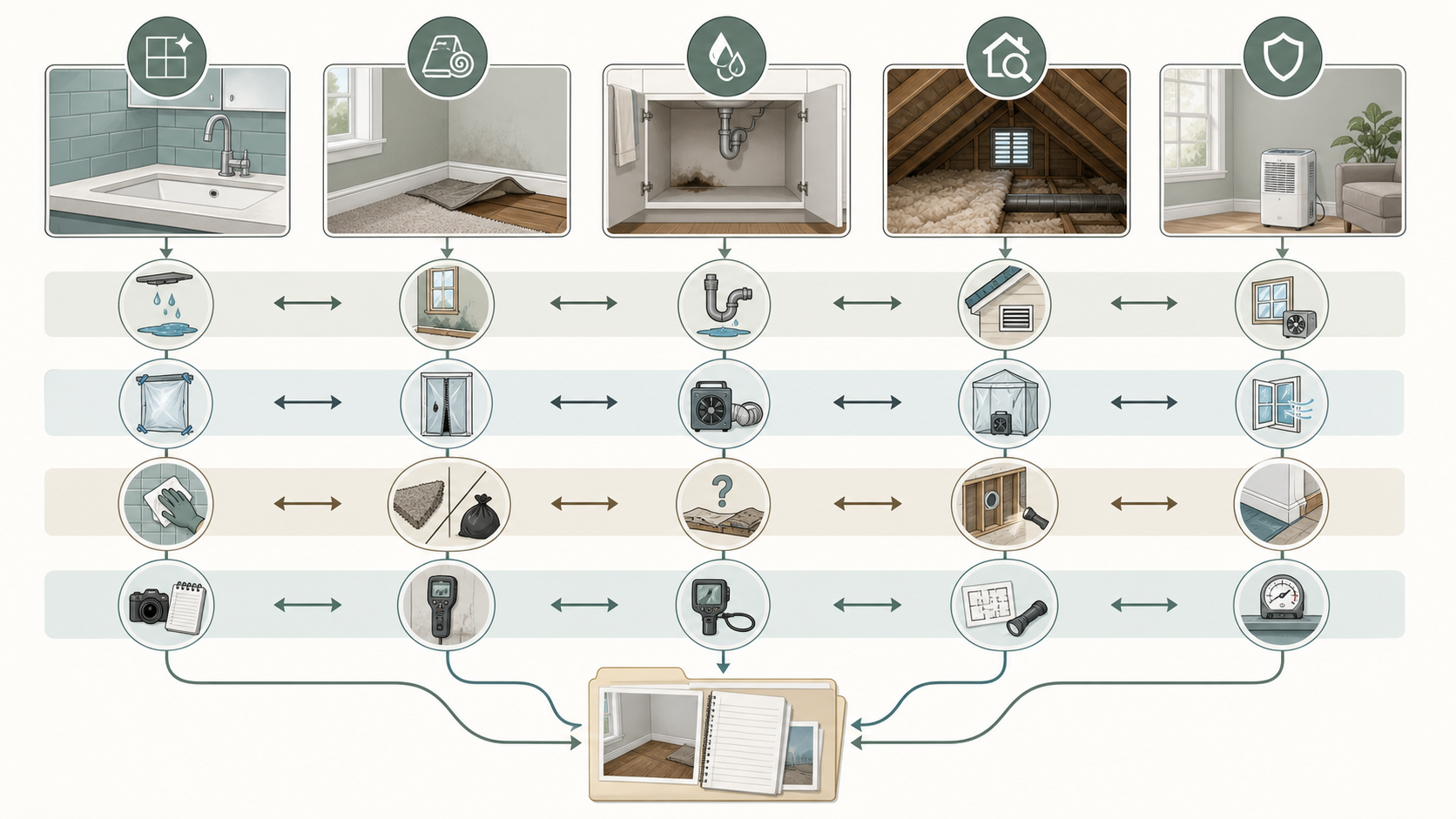
Match the response to the scale and uncertainty
Health Canada organizes cleanup decisions by the amount of visible growth and recommends professional assessment and cleanup for large areas. It also suggests professional help when the moisture source or corrective action is unclear, when growth returns, or when structural elements are involved.
A small, clearly bounded area on a washable surface with a resolved moisture source may have a different path from widespread growth after a roof leak. Multiple patches across rooms may indicate a broader moisture issue even when each patch looks limited. The response should become more controlled as area, material damage, occupant sensitivity, hidden conditions, and uncertainty increase.
Understand the parts of a complete treatment plan
A professional scope should connect investigation, source correction, work-area control, material decisions, cleaning, drying, waste handling, and verification. Product application is only one possible step. Ask what evidence led to each part of the scope.
| Plan component | Question to ask | Evidence to expect |
|---|---|---|
| Moisture source | What is making the material damp? | Observed condition, measurement, or building review |
| Extent | What visible and suspected areas are included? | Room map, photographs, boundaries, assumptions |
| Material decision | What can be cleaned and what should be removed? | Material-specific rationale |
| Work-area controls | How will occupants and clean areas be separated? | Access, isolation, airflow, cleanup, and waste plan |
| Completion | How will the team show that the scope was performed? | Dryness, visual review, records, and open-item list |
Moisture correction may involve another trade
The party cleaning mould may not be the party who repairs a roof, plumbing line, exterior wall, foundation, drainage system, or ventilation design. Identify those interfaces. If the moisture source is not corrected before reconstruction, new material may be exposed to the same condition.
Sequence the work so investigation informs source repair, source repair supports drying, and drying supports removal, cleaning, and rebuild. In an active leak, temporary containment of water may be an urgent step, but it should be followed by a durable correction appropriate to the building.
Be careful with product-centred claims
A strong smell, a brightened surface, or a product label does not by itself establish that affected material is sound or the moisture source is resolved. Health Canada's home guidance advises cleaning washable surfaces with an unscented soap solution and says not to use bleach for mould cleanup. It also notes that painting over a mouldy surface only hides the problem temporarily.
Professional projects may involve methods and products selected for the material and work plan. Ask why a product is being used, where it will be applied, what preparation is needed, and what it cannot accomplish. Treatment should not substitute for removal of material that cannot be properly cleaned.
Plan around occupants and the work area
Before work begins, identify who uses the space, how they will be kept away from the work area, and how clean routes will be maintained. Health Canada advises keeping more susceptible individuals away from mould cleanup. Pets, belongings, food, and sensitive equipment may also need to be relocated or protected.
Ask how the work area will be isolated when appropriate, how tools and debris will move, how the area will be cleaned, and when occupants can re-enter under the project plan. Do not infer one universal re-entry time. It depends on the condition, method, drying, and other work occurring in the space.
Compare professional scopes line by line
Two estimates may use the word remediation while describing different work. Normalize them. Identify the rooms, area assumptions, moisture investigation, source work, contents, isolation, material removal, cleaning, drying, waste, rebuild, documentation, and exclusions. Ask who is responsible for plumbing, roofing, ventilation, electrical, or reconstruction work outside the cleanup scope.
Keep optional testing separate from the core plan. Health Canada says routine air testing often provides little information about the cause and cannot predict health effects. If a professional recommends a test for an unresolved condition, ask what question the test will answer and how each possible result would change the work.
Also compare what happens after removal. One scope may stop at cleaning, while another may include drying records, minor reconstruction, ventilation recommendations, or coordination with another trade. Neither is automatically better; the owner needs to see the boundary. Ask for a room-by-room list of included work, excluded work, owner responsibilities, and the condition in which the space will be returned.
Define completion without overpromising
Completion criteria can include correction of the identified moisture source, removal or cleaning of included material, a dry and visibly clean work area, photographs, moisture records, and a list of items outside scope. For extensive work, Health Canada suggests considering an independent post-remediation review.
No contractor can make a building permanently free of every mould spore. The practical goal is to remove indoor growth included in the scope, correct the moisture condition that supported it, dry the area, and maintain conditions that reduce recurrence risk. Future leaks, humidity, or building changes still need attention.
Mold treatment decision checklist
- Record visible growth, odour, water history, and affected rooms.
- Identify or investigate the moisture source before cosmetic work.
- Classify the materials and signs of damage.
- Keep susceptible occupants away from cleanup activity.
- Choose a response path based on extent, uncertainty, and material.
- Compare source correction, controls, removal, cleaning, drying, and rebuild.
- Agree on documentation and completion evidence.
- Monitor the repaired area for renewed dampness or odour.
Common treatment mistakes to avoid
- Starting with a product: the water source and material condition should guide the method.
- Painting over visible growth: appearance can change while the condition remains.
- Relying on colour: extent, moisture, material, and exposure matter more.
- Disturbing a large area without controls: plan access, isolation, and debris handling first.
- Ignoring adjacent systems: roof, plumbing, ventilation, or drainage work may be necessary.
- Accepting a vague finish line: define included areas and completion evidence.
Frequently asked questions
What is the best mold treatment?
There is no single best product or method. The response should address the moisture source, extent, material, work-area controls, removal or cleaning, drying, and verification for the specific condition.
Should mold be tested before treatment?
Health Canada does not generally recommend routine air testing. Visible mould and moisture should be addressed. A professional may suggest targeted investigation when the condition remains unclear.
Can mold come back after cleanup?
Growth can return if material becomes damp again or the original source was not corrected. Monitor the area and respond quickly to leaks, condensation, or renewed odour.
When should a professional assess the area?
Seek professional input for a large area, repeated growth, unclear moisture, hidden conditions, structural involvement, or a scope that cannot be isolated and handled safely by the occupant.
Contact ASM Mold Removal with the situation mapped
A reliable mold treatment decision begins with moisture evidence and ends with a documented, dry, visibly clean area and a plan for the underlying building condition. Review ASM's current service information on the official site and compare it with the authoritative guidance below.
Authoritative sources reviewed
- ASM Mold Removal official site and contact page — current first-party service and inquiry context.
- Health Canada guide to addressing moisture and mould indoors — moisture, visible growth, material and professional-help decision context.
- U.S. EPA remediation guide — additional general material, method and scope-comparison context.